SHIELD is a real coastal protection experiment on Singapore's shoreline — steel cages, shells from restaurant kitchens, and a low-voltage mineral coating that grows on the structure while it sits in the sea. A meaningful part of it is done by hand, on land, by people who show up.
No marine biology degree required. No boat required. Mostly buckets, fresh water, sunshine and mesh bags. Below are four ways in, an honest description of what the work feels like, and two email addresses that reach actual people.
Every route below ends in the same place: the sign-up form above, or an email if you prefer. Pick whichever fits; if you email, use the button and the subject line will already be filled in for you.
Route 01
Volunteer
Hands-on shell work, and the bulk of what the community actually does. Collection from restaurants. Sorting. Washing every shell in fresh water. Laying shells out flat to sun-dry. Then, weeks later, packing the dried shells into biopolymer mesh bags — double-bagged, a lesson carried over from the 2024 pilot because it rips less and costs less to maintain.
No experience needed. Nothing you learn here takes more than five minutes to explain.
Divert your shell waste instead of paying to dispose of it. Oysters, mussels and cockles are exactly the material the reef is built from — the whole system is designed around discarded shells from local restaurants.
Tell us roughly what species you go through and how often, and we will work out collection with you. Volumes and collection schedules are still to be confirmed while the staging site is arranged.
The proposal explicitly plans to engage local organisations to assist in preparation works — collecting and processing shellfish material from restaurants — with the aim of fostering environmental stewardship. There is also a citizen science role in biodiversity monitoring alongside the WP3 surveys.
That makes it workable for a class, a CCA group, a corporate volunteering day or an NGO. Tell us your group size and what you are hoping people take away.
Marine biology, coastal engineering, landscape, social science. Work Package 3 covers intertidal biodiversity surveys — baseline before deployment, then at regular intervals — plus water quality, sediment dynamics and qualitative interviews on how the public perceives and relates to the reef.
If your work overlaps with any of that, or you want to bring a method we have not thought of, write to us.
Nobody is going to tell you this is glamorous, so here it is straight. It is outdoors. It smells of the sea, because it is the sea. There are buckets, a lot of fresh water, and a lot of laying shells out flat in the sun so they dry evenly.
It is repetitive, and oddly satisfying — the kind of work where you look up and an hour has gone. It is also, genuinely, the step that makes the reef possible. Nothing goes in the water until the shells have been through it.
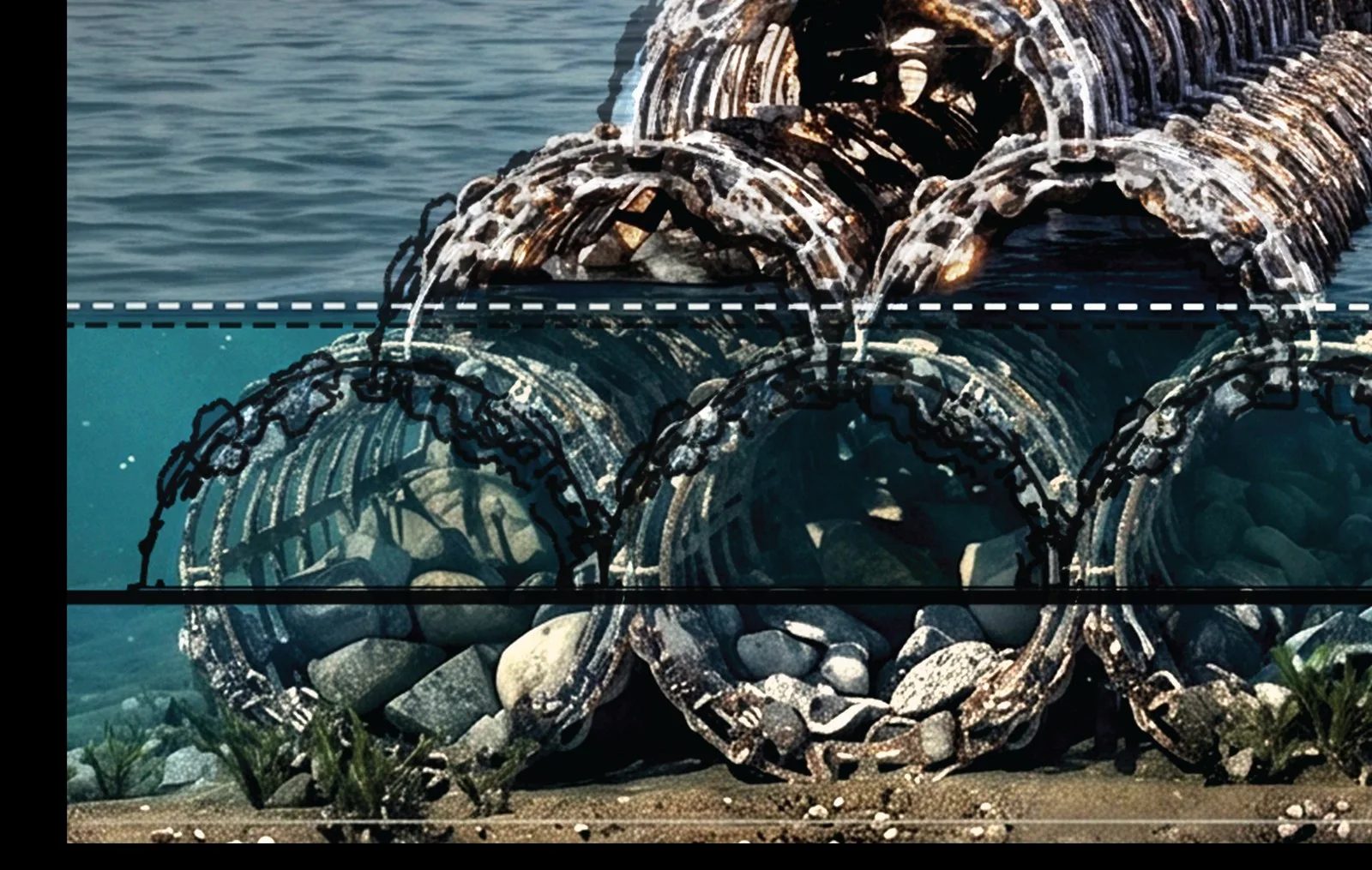
Fig. 01 Where the hand work ends up: shells packed into the cages at the waterline. Every shell in this frame was washed and sun-dried on land first.
Step 01
Collection
Shells come from local restaurants — oysters, mussels, cockles. This is a waste stream being redirected, not shells taken from a shore.
Step 02
Sorting
Species get separated, and anything that is not shell comes out. Two configurations are being tested — Biorock filled with oyster shells, and Biorock filled with mixed shells — so keeping the material sorted actually matters to the experiment.
Step 03
Freshwater cleaning
Every shell is cleaned with fresh water. This is the first half of the biosecurity method, and it is not optional or approximate.
Step 04
Laying out to sun-dry
Shells are spread out flat and sun-dried for weeks. Prolonged UV exposure naturally sterilises the shell surface, and marine species cannot survive that much desiccation. This is the method the 2024 pilot in Singapore proved.
Step 05
Bagging
Dried shells are packed into biopolymer mesh bags and double-bagged. The bags only need to hold the shells together at deployment — they are designed to biodegrade after at least five years, by which point biological growth has cemented the shells to each other.
Scheduling — to be confirmed
We are not going to invent a date for you.
Session dates, locations and durations are still being arranged. The waterfront staging area where bags get prepared is to be confirmed — HSL Constructor is providing a temporary site for assembly and preparatory activities, and the reef site itself is still to be confirmed by PUB. The grant period runs from 1 May 2026 to 30 April 2029, so there is a long runway ahead.
So the honest ask is small: email us, tell us which route you are interested in, and we will tell you the moment shifts open. That is the entire commitment.
Roughly 70% of Singapore's coastline is guarded by hard structures — engineered revetments and seawalls. They work, and they will keep working. But they generally serve a single function, they are less biodiverse, and they are poorly integrated with the way people actually use the coast.
A shellfish reef can break waves, build habitat, and make a place people want to be — at the same time, in the same footprint. On a coastline with very little spare land or sea space, that is not a small difference.
70%of Singapore's coastline is guarded by hard engineered structures — effective, but usually single-purpose.
3×species richness tripled in the 2024 Witteveen+Bos pilot — Singapore's first artificial oyster reef, built from bagged shellfish units.
49%of shells in that same pilot showed spat recruitment — young shellfish settling on the material by themselves.
Circularity
Every shell you wash is waste diverted from landfill.
The shells come from restaurants, where they would otherwise be disposed of. Sending them into a coastal structure instead is the "trash to treasure" logic of the Zero Waste Masterplan and the Sustainable Living pillar of the Singapore Green Plan 2030 — which targets a 30% cut in waste sent to landfill by 2030.
The same project also sits under the Green Plan's Resilient Future pillar: nature-based enhancements that adapt to sea-level rise. One pile of shells, two national targets.
There is no form here and no queue. These addresses reach real people working on the project, and a two-line email is a perfectly good first message. Tell us what you would like to do and we will reply.
Volunteering & shell donations
shellforce@cca-sg.com
Best for individuals who want to join a shift, and for restaurants and F&B businesses with shells to divert.
SHIELD is run out of the Centre for Climate Adaptation at SUTD, directed by Prof. Eva Castro, Professor of Practice in Landscape Urbanism. The centre operates as a multi-centre with Pratt Institute, Pace University and Aalto University.
Including the awkward ones. Where something has not been decided yet, the answer says so.
Do I need experience, or to be able to swim?
No to both. The community work is on land: collecting, sorting, washing shells in fresh water, laying them out to dry and packing them into mesh bags. The in-water work — positioning cages, anchoring, pinning the network together — is done by divers and a surface crew from a workboat, and is not volunteer work.
Isn't putting shells back in the sea a risk for invasive species?
It is a real risk, and it is exactly why the preparation is so slow. Every shell is cleaned with fresh water and then sun-dried for weeks. Sufficient UV exposure from the sun naturally sterilises the surface of the shells, and marine species cannot survive such prolonged desiccation. This was demonstrated in the 2024 pilot in Singapore, and the same method is being carried into SHIELD.
Can I bring shells I collected from a beach?
Please don't. Shells on a beach are habitat, and they should stay where they are. This project is specifically about diverting a restaurant waste stream — discarded oyster, mussel and cockle shells that would otherwise be thrown away. If you want to help with material, the useful thing is a kitchen, not a shore.
Where will the reef actually be?
NSRCC beach — the National Service Resort & Country Club, on the East Coast of mainland Singapore — is the shoreline assumed in the proposal. The final site is to be confirmed by PUB. The site criteria are a sandy beach or mudflat, significant wave action with a history of erosion, natural shellfish populations nearby for recruitment, and moderate public access.
When does it start?
The grant period runs from 1 May 2026 to 30 April 2029. Volunteer session dates, locations and durations within that window are still being arranged and are to be confirmed. We would rather tell you nothing than tell you a date we have made up — email us and you will hear as soon as there is something real to sign up for.
Is the electrified structure safe?
It is a low-voltage system, powered by one or two solar panels mounted nearby. The electrolysis grows a limestone mineral coating on the submerged steel, which prevents the steel from rusting, strengthens the structure over time and accelerates the growth of marine organisms. Clear informational signage will be placed at the site to explain the project, and the project area may be fenced during works.
Who is behind this?
The Singapore University of Technology and Design is the host institution, with Mlion Corporation Pte Ltd as partner institution. Witteveen+Bos South-East Asia provides ecological validation and hydrodynamic modelling, and HSL Constructor provides construction support. It is funded by PUB on behalf of the National Research Foundation, under the Coastal Protection and Flood Management Research Programme (Living Lab), reference CFRP-LL01-0004.
What happens to the shells long-term?
The biopolymer mesh bags are designed to biodegrade after at least five years. Their only job is to hold loose shells together at the moment of deployment — by the time they break down, biological growth has joined the shells together into a solid mass. The bag disappears; the reef stays.
This is not a side project run out of a garage. SHIELD is a funded Living Lab with a named research team, industry partners and an engineering consultancy validating the ecology and the hydrodynamics.
Which also means the volunteer work is not decorative. The shells you wash go into a structure that will be instrumented, surveyed and reported on for at least a year after deployment.
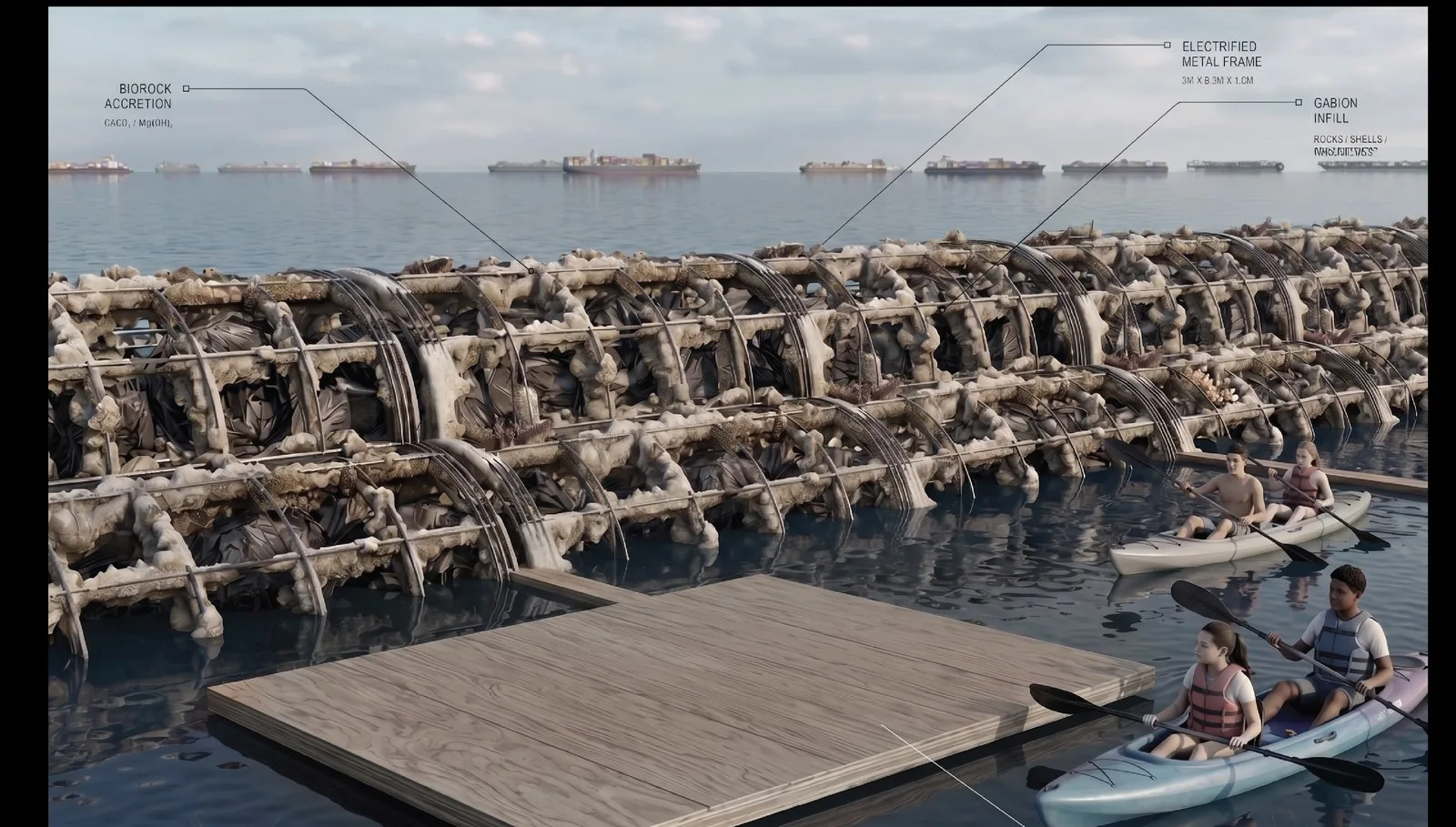
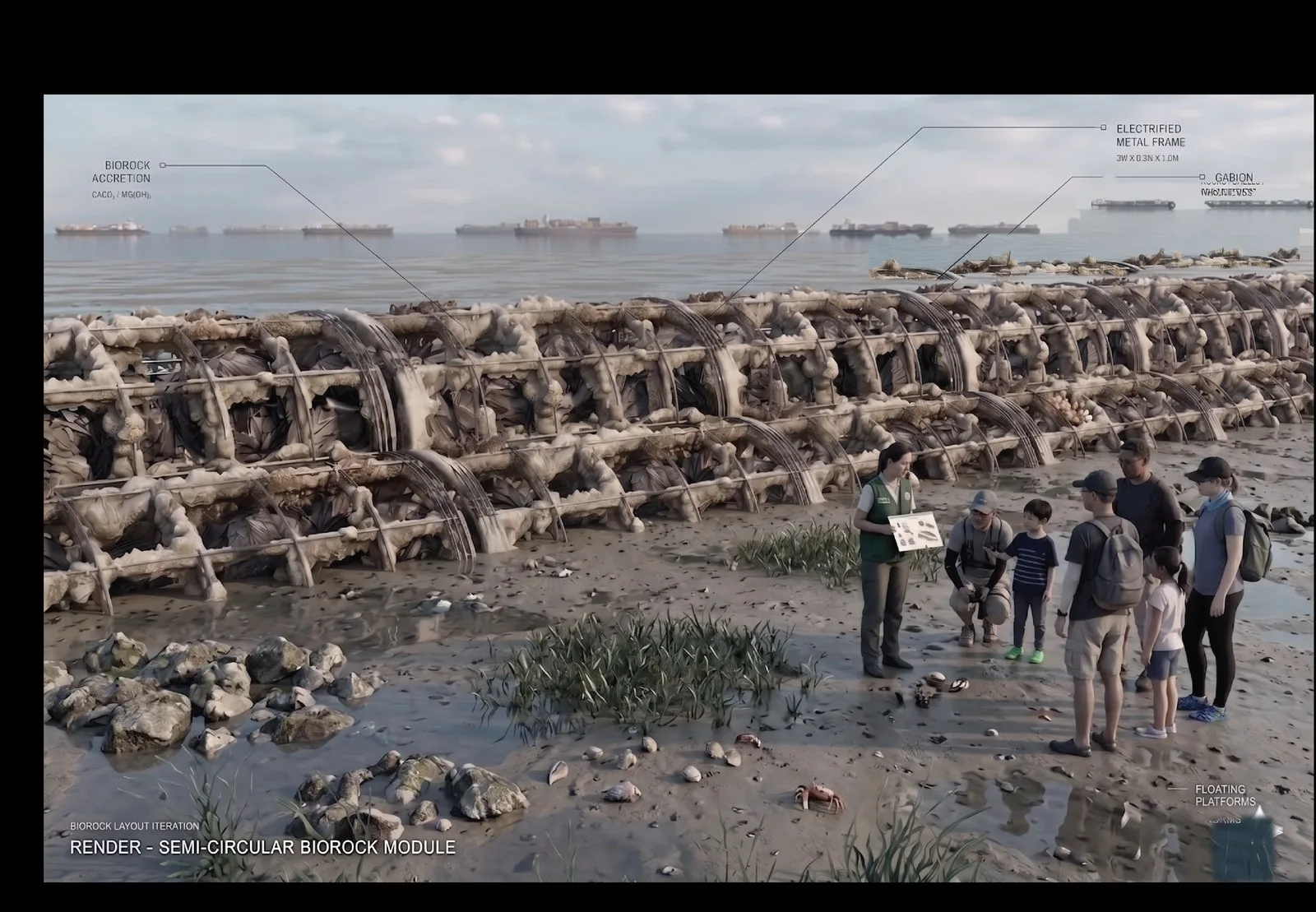
Fig. 02 The reef is designed to be occupied as well as functional — a "kit of parts" of floating platforms, fish pans, small piers and floating gardens can be attached to it.
Host institution Singapore University of Technology and Design
Partner institution Mlion Corporation Pte Ltd
Ecology & modelling Witteveen+Bos South-East Asia
Construction support HSL Constructor
Funder — administering PUB Singapore
Funder — on behalf of National Research Foundation
Programme Coastal Protection and Flood Management Research Programme (Living Lab)
Lead PI
Prof. Eva Castro — SUTD
Professor of Practice in Landscape Urbanism and director of the Centre for Climate Adaptation at SUTD. Leads Work Package 1, landscape integration and conceptual reef system design.
Co-Investigator
Eric Leong — Mlion Corporation
Founder and CEO of Mlion Corporation. Leads Work Package 2 — steel cage engineering, shell cleaning and packing, fabrication, installation and electrification.
Co-Investigator
Jaïr Smits — SUTD
Leads Work Package 3 — baseline surveys, environmental impact assessment and monitoring for at least a year after deployment. This is the work package citizen science plugs into.
Before you write
Three pages worth five minutes.
You do not need any of this to volunteer. But if you would like to know what you are signing up to before you send an email, start here.
Shell to breakwater: The full eleven-step journey — restaurant collection, cleaning, sun-drying, bagging, staging, workboat, anchoring, electrification.
Which shells we need: Oysters, mussels and cockles from local restaurants — what counts as usable material, and what does not.
Why this coastline: Reclamation, hard defences and erosion on the East Coast — how Singapore's shoreline came to look the way it does.
One last thing
Bring your hands. We'll bring the shells.
Coastal protection usually happens somewhere else, decided by someone else, out of sight. This one gets built partly by whoever turns up with a bucket. If that appeals to you, send a short email — that is genuinely the whole first step.